Clean energy blog

Blog

Last week, I had the opportunity to attend the 2026 TEAMER Deck Operations Workshop in Wanchese, North Carolina. Hosted by TEAMER and the Coastal Studies Institute (CSI), this three-day, hands-on training program brought together marine energy researchers, developers, students, and industry professionals from across the United States to focus on one critical topic: how to safely and efficiently deploy marine energy technologies in the real world.

As many of you know, Pterofin is still in the research and development stage. We are currently awaiting the results of our ongoing CFD analysis being conducted through our TEAMER-supported project with NLR. While we're still several months away from putting a Skimmer prototype into the water, this workshop provided invaluable insight into what comes next.

One lesson stood above all others:

An hour spent designing for deployment can save ten hours of headaches in the field.

That idea was reinforced throughout the entire workshop.

The marine energy industry often focuses heavily on hydrodynamics, power production, and performance optimization. While those things are obviously important, I learned that deployment logistics can ultimately determine whether a project succeeds or fails. A device that performs well in a computer model but is difficult to transport, launch, recover, inspect, or maintain can quickly become impractical and expensive.

Over the course of three days, participants received training in a wide range of operational topics, including:
  • Lessons learned from previous marine energy deployments
  • Safety culture and risk management
  • Environmental considerations and permitting
  • Rigging fundamentals and safe lifting practices
  • Scenario planning and operational decision-making
  • Dive team integration and underwater operations
  • Vessel-based deck operations
  • Emergency communications
  • Crane operations
  • Wave Energy Converter (WEC) deployment exercises
  • Man-overboard recovery procedures
  • Firefighting and vessel inspections
  • Offshore emergency flare drills
  • Marine Technology Society (MTS) skills assessments and micro-credential training
One of the most valuable aspects of the workshop was seeing how many different disciplines must work together during a deployment. Engineers, vessel operators, crane crews, divers, safety officers, environmental specialists, and communications personnel all play critical roles. The workshop emphasized that successful deployments depend just as much on coordination and planning as they do on engineering.

The event also focused heavily on "design-for-deployment" principles. Participants worked through mock deployment scenarios, identified potential operational challenges, and learned how small design choices can dramatically affect transportation, handling, launch, recovery, maintenance, and overall project costs.

For Pterofin, this was especially valuable.

As we continue refining the Skimmer design, I now have a much clearer understanding of how the device should be designed not only to generate power, but also to be transported, assembled, deployed, recovered, and serviced efficiently in the field. These considerations will become increasingly important as we move from numerical modeling toward prototype testing and eventual pilot deployments.

The workshop included hands-on activities aboard the Miss Caroline research vessel, operations at the Coastal Studies Institute's marine facilities, exercises at Jennette's Pier, and offshore training aboard the Discovery vessel. Participants rotated through real-world deployment scenarios and learned directly from experienced marine operations professionals.

Perhaps most importantly, I left with a better understanding of the pathway from concept to deployment. Marine energy technologies don't reach the water by accident. They get there through careful planning, disciplined engineering, strong safety practices, and thoughtful consideration of how every component will be handled throughout its lifecycle.

I'd like to thank TEAMER, the Coastal Studies Institute, Pacific Ocean Energy Trust (POET), and all of the instructors, vessel crews, and organizers who made this workshop possible. The experience provided practical knowledge that will directly influence the future development of the Pterofin Skimmer.

We're still waiting on the results of our current CFD work, but when the time comes to put a prototype in the water, the lessons learned during this workshop will help ensure we're prepared.

The path to deployment is becoming much clearer.

And that's an exciting step forward for Pterofin.

The 2026 TEAMER Deck Operations Workshop was held July 7–9, 2026, at the Coastal Studies Institute in Wanchese, North Carolina. The workshop was organized by TEAMER (Testing Expertise and Access for Marine Energy) and focused on hands-on marine energy deployment training, design-for-deployment principles, safety, vessel operations, and workforce development for the marine energy industry.
It has been a little while since our last Pterofin blog update, and there is a good reason for that: we have been waiting for the next major round of results from our ongoing research work with the team at NLR through the TEAMER program.

Over the past several weeks, the team has been running CFD simulations to help evaluate Pterofin's potential performance and develop a clearer understanding of what our power curve may look like. As often happens with complex computational work, the process has taken longer than expected. There were a few early setbacks and technical errors that had to be resolved, but the simulations now appear to be running properly.

At this point, it is still too early to know what the final CFD results will show. The team has indicated that the analysis may not be ready by our next scheduled meeting and could take closer to four more weeks before the results are available. After that, they will prepare their final findings and submit the completed work back through TEAMER for review and approval.

So, for those of you who have been patiently waiting to hear more about our testing and potential power curve, you are not alone. I have been just as eager to see the final results and share them publicly.

The early BEM results have been encouraging, and we are hopeful that the CFD analysis will help validate and strengthen what those initial results suggested. If the CFD results align with the BEM findings, it would be a very exciting step forward for Pterofin and could point to a power curve that is stronger than many might have expected at this stage.

That said, this is exactly why we are doing the work. Whether the results are good, bad, or somewhere in between, we are committed to sharing what we learn. Progress in research and development can be painstakingly slow, especially when the questions being answered are complex, but each step brings us closer to understanding the true potential of Pterofin's oscillating-wing energy technology.

We are hopeful that in about four weeks, we will have a much clearer update to share. Until then, we are staying patient, keeping our fingers crossed, and looking forward to what the data tells us next.
Pterofin's latest BEM sweep is doing what we hoped it would do: helping narrow the design space.

Rather than producing a single headline number and pretending the work is finished, the current modeling is identifying directional trends in how the Skimmer appears to respond to different operating parameters. In the latest sweep, performance increased with higher flap frequency, higher flap squareness, and higher pitch squareness. The best-performing case in this sweep also appeared near the upper end of the tested range, suggesting that the model is beginning to isolate a more promising operating region.

That matters because this stage of the TEAMER work is about focus. The broader modeling plan uses reduced-order BEM runs to explore a large design space efficiently, optimize pitch schedules, and identify the cases that deserve higher-fidelity CFD analysis. The objective is not only to improve mechanical power, but also to understand related design loads such as pitching torque and thrust, which matter for practical hardware development.

Just as important, this work is being treated with the right level of caution. The modeling plan is explicit that BEM has limitations in highly unsteady flow and that full-scale CFD comparisons are needed to quantify where the lower-fidelity model is reliable and where it is not. In other words, the latest sweep is not the end of the process. It is a useful filter for where to look next.

That is real progress. The search is becoming less open-ended. We are starting to see which combinations of motion and control parameters look more promising, and that gives the next round of higher-fidelity analysis a better target.
Over the past few months, we've been working closely with the National Laboratory of the Rockies (NLR) through TEAMER RFTS-15 to answer one of the most important questions for Pterofin:

How much power can this system actually produce across real-world conditions?

That answer lives in a single deliverable: a power curve.

And building it is proving to be exactly as challenging—and as important—as expected.

What You're Looking At

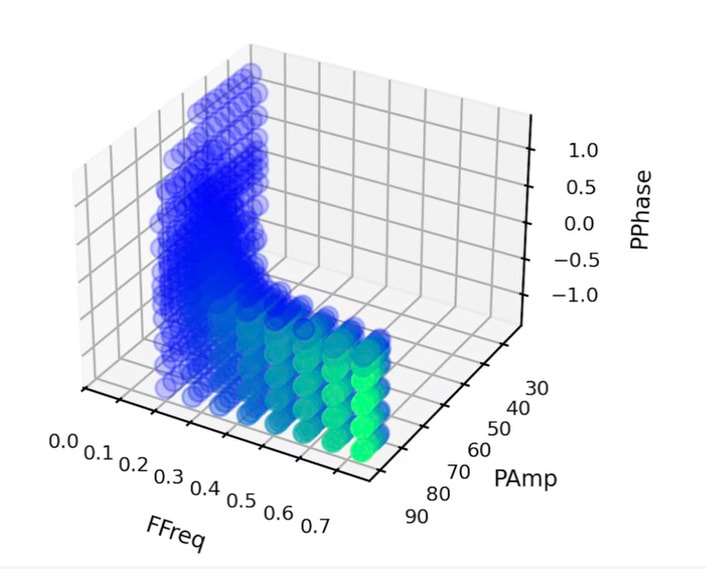
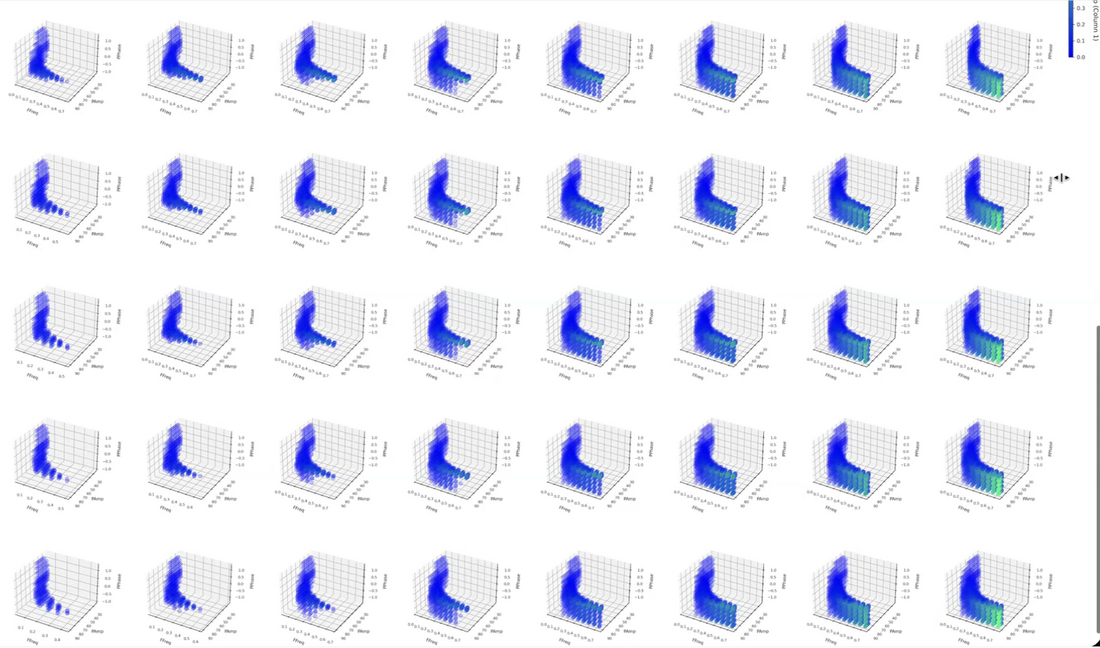
Below are early-stage modeling outputs from the NLR team:
  • Each point represents a simulated operating condition
  • Axes include frequency, amplitude, and phase
  • Color represents estimated efficiency (Cp)
Blue indicates lower efficiency. Green indicates higher efficiency.

These plots are not final results. They are part of an iterative process to understand how the system behaves across a wide range of conditions.

Why This Is Taking Time

At first glance, you might expect modeling to give quick answers. It doesn't.

The physics driving Pterofin's performance are fundamentally different from traditional turbines.

Instead of steady rotation, we rely on unsteady flow—where lift, vortices, and timing all interact dynamically. Interestingly, some of the earliest outputs exceeded physical limits. While not usable as results, these cases helped isolate where the model was overpredicting lift and revealed how sensitive performance is to timing and dynamic stall behavior.

That creates two problems:

1. The Physics Are Hard to Model

Small changes in timing or angle of attack can produce large changes in performance.

Early in the modeling process, some simulations produced Cp values that exceeded physical limits.

That's not a breakthrough—it's a signal that something in the model is wrong.

In this case, much of the issue traced back to how dynamic stall was being modeled, along with smaller post-processing errors.

Those issues are now largely resolved.

But not completely.

2. "Better" Doesn't Mean "Validated"

The current results are significantly improved. The trends are becoming clearer. The outputs are more reasonable.

But they are still not validated.

To move from "interesting" to "decision-grade," the team must:
  • Run higher-fidelity CFD simulations
  • Compare results against known physics
  • Eventually tie everything back to experimental data
Even CFD is not the final authority. True validation requires agreement with physical testing.
This is why power curves take time.

What's Actually Encouraging

Even with those constraints, the data is already telling us something important.

Across many of these plots, a consistent pattern is emerging:
  • Performance improves within specific regions of frequency and amplitude
  • There appears to be a structured "ridge" where efficiency increases
  • The system is highly sensitive to timing and phase relationships
This is exactly what we would expect from a system designed to leverage unsteady aerodynamic effects, where timing—not just shape—drives performance.

In other words:

We are not looking at random noise.

We are starting to see structure.
Across multiple runs, a consistent performance ridge is emerging—indicating that efficiency is not random, but concentrated within a specific operating regime defined by frequency, amplitude, and timing.
The system is showing clear sensitivity to how angle of attack evolves through the cycle, reinforcing that timing—not just geometry—is driving performance.


What Comes Next

The current phase is about narrowing the design space—not declaring victory.
Next steps include:
  • Refining angle-of-attack behavior across the cycle
  • Improving model fidelity where discrepancies remain
  • Running CFD to validate key trends
  • Building toward a defensible, publishable power curve
A validated power curve is what enables system sizing, revenue modeling, and ultimately real-world deployment decisions. Only after those steps will we have the kind of results that partners, investors, and operators can rely on.

The Reality

There is a temptation in early-stage energy technology to jump from promising data to bold claims.

We are not doing that.

What we have today is:
  • Early signals that align with the underlying physics
  • A clearer picture of where performance lives
  • A modeling framework that is improving—but not finished
What we do not have yet is a validated power curve.

Why This Still Matters

This stage is where most energy technologies fail.

The transition from concept to quantified performance is where most technologies fail.

It's also where real value is created.

As this process continues, we are moving from visually promising results to defensible performance. A result that can stand up to scrutiny. The current results are not final—but they are converging.

If you've been following along, this is the phase where things start to get real.
We're continuing to make steady progress on the modeling effort for Pterofin's oscillating fin system through our collaboration with the National Laboratory of the Rockies. As the simulations run across a wide range of operating conditions, early outputs are starting to come through. In some cases, those initial results fall outside what we would expect from a physical system. When that happens, it's a clear signal to pause, review the model, and ensure everything is behaving as intended before moving forward.
That level of diligence is critical. The objective isn't to generate numbers quickly, but to generate results that are accurate, repeatable, and grounded in real physics.
At the same time, the data is already helping guide how the design should evolve. One of the more interesting observations so far is how the angle of attack varies along the span of the fin. Instead of behaving as a uniform surface, different sections of the fin operate under different conditions at the same moment in time.
That insight points toward potential improvements in both geometry and motion. Moving beyond a simple rectangular fin toward a more tapered or elliptical shape, combined with some level of controlled twist along the span, could allow more of the fin to operate in a productive range throughout the stroke.
This is exactly the kind of refinement the modeling effort is intended to support.
We're taking the time to get this right so that when we share the power curve, it's something that can be trusted.
More to come soon.

How Pterofin and the National Laboratory of the Rockies are narrowing in on real-world performance

One of the biggest questions any investor or partner will ask a new energy hardware company is simple:
How much power will it actually produce in the real world?

That answer lives in a power curve—a chart that shows expected power output at different water current speeds. And right now, through TEAMER RFTS-15, Pterofin is working with the U.S. Department of Energy's National Laboratory of the Rockies (NLR, formerly NREL) to build that curve with national-lab rigor.

Why this takes weeks (not days)
The Pterofin Skimmer isn't a typical turbine. It uses an oscillating hydrofoil, and performance depends on several "settings" working together—how far the foil swings, how fast it moves, and how the foil pitches during each swing.

So instead of modeling one scenario, the research team is running a large design-space sweep: a structured set of 3.3 million virtual operating cases. Each case is like a controlled experiment that tests a different combination of motion and control settings.

The goal is to map out:
  • where the Skimmer produces high, stable power
  • how efficiency changes across operating conditions
  • how loads behave (important for durability and realistic deployment)
  • which operating regions are repeatable and robust, not just "peak performance"

This modeling sweep is designed to deliver decision-grade outputs that help us make smarter choices about the Skimmer's next design iteration and its path to pilot deployment, including:
  • a defensible power curve
  • efficiency trends across realistic operating conditions
  • load and operating-envelope insights that reduce risk before building larger hardware

This is the behind-the-scenes work that turns a promising concept into something measurable. It helps answer, with evidence, what serious partners need to know before moving forward: expected output, realistic operating limits, and confidence in performance.
Pterofin was founded on a simple idea: nature has already spent millions of years refining solutions that move efficiently through water. Our job is to translate that wisdom into practical, scalable clean energy—technology that can thrive alongside the environments it touches. Today, we're excited to share a major step forward on that journey: our TEAMER RFTS-15 collaboration with the U.S. Department of Energy's National Laboratory of the Rockies (NLR, formerly the National Renewable Energy Laboratory—NREL) is well underway, and it's focused on the milestone that matters most to serious partners: a defensible power curve and efficiency trends across realistic operating conditions.

Why is this such a big deal? Because a power curve is where innovation becomes measurable. It's the bridge between "this looks promising" and "this is decision-grade." When you can quantify expected output across flow speeds—and understand the efficiency tradeoffs, loads, and operating envelope—you can make smart engineering decisions, forecast performance, estimate costs more credibly, and plan pilot deployments with far greater confidence. It's the type of rigorous foundation that investors and strategic partners look for when evaluating climate hardware.

This work builds directly on the technical support that helped validate the Skimmer concept in earlier stages. In July of 2021, Pterofin was selected through TEAMER RFTS-3 to work with the Applied Research Laboratory to test a scaled model of the Pterofin Skimmer prototype concept. That testing opportunity helped confirm key mechanical and operational characteristics and provided valuable insight into how flow behaves around the foil while we collected raw performance data. Over time, the resulting report and data were prepared for public release through the Marine and Hydrokinetic Data Repository, where DOE-supported marine energy results are shared to accelerate learning across the industry.

Now, with TEAMER RFTS-15, we've reached the next phase: transforming prototype learnings and lower-fidelity estimates into a broader and more reliable performance picture. The Skimmer is a marine energy system designed to harness energy near the water surface using an oscillating hydrofoil. The foil oscillates about a driveshaft in a pendulum-like motion, and near the end of each swing it also pitches about its spanwise axis so the leading edge stays oriented upstream in the relative flow. A counterbalance and control system regulate that motion, while the powertrain converts oscillatory movement into single-direction rotation to drive a generator. This approach is designed to perform in lower-flow environments and in settings where traditional turbines can struggle—especially in shallow or constrained deployment areas.

Historically, our development combined experimental prototype testing with low-fidelity modeling. Testing proved viability, but physical prototypes naturally limit how many configurations and operating conditions you can explore. Analytical models offered early estimates but didn't capture important real-world dynamics that influence output, such as induction effects, unsteady separation behavior, and variable lift characteristics across changing angles and flow conditions. The goal of this TEAMER RFTS-15 effort is to expand the design space we can confidently explore and to identify which geometric and operational choices drive the biggest improvements—while also quantifying the uncertainty inherent in different modeling methods.

NLR's technical support uses a disciplined two-stage modeling approach. First, a broad parameter sweep is run using a reduced-order Blade Element Momentum (BEM) model, which is computationally efficient and well suited for exploring many configurations. This step helps reveal sensitivities and quickly identify the most promising (and most informative) cases. Next, selected cases are evaluated with higher-fidelity Computational Fluid Dynamics (CFD), which provides a more detailed representation of device performance and hydrodynamic loads—particularly important when unsteady effects become significant. Together, these approaches help us understand not just what might work, but why—and how reliable each prediction is.

Across this campaign, the team is evaluating metrics that directly connect to commercial relevance: driveshaft torque and rotational speed, mechanical power, hydrofoil pitching torque, and system thrust/load trends. Higher-fidelity CFD results can be compared against available lab-scale experimental data, while BEM results are benchmarked against CFD predictions to characterize accuracy and error bounds. That comparison—reduced order vs. high fidelity—is crucial for building confidence in the modeling tools we'll continue to use as we refine designs and prepare for larger-scale validation.

For Pterofin, this work is more than another technical milestone. It's an inflection point. When power curve and efficiency trends are available in a form that can be shared publicly, it becomes far easier to align on next steps: which configuration to prioritize, what control strategy is most promising, what loads and operational limits look like, and what pilot conditions best demonstrate performance. It accelerates the path from engineering to deployment—and it strengthens the credibility of every downstream conversation, from pilot partners to grid and infrastructure stakeholders.

As the results package is finalized and prepared for release, we'll publish a clear public summary of the headline findings and what they mean for the Skimmer's path to commercialization. If you'd like to follow along—or if you're an investor, strategic partner, or potential pilot host interested in supporting the next phase of validation—visit our collaboration update page here:
https://www.pterofin.com/national-renewable-energy-laboratory.html

The clean-energy future will be built by technologies that perform, endure, and integrate responsibly. We believe nature's playbook still has a lot to teach us—and with national-lab rigor helping quantify what the Skimmer can do, we're taking a major step toward proving it.
Since our last update, we've been making steady progress toward our goals, and we're excited to share a few details on the next steps in our journey. As we mentioned, our testing with ARL through the TEAMER program provided valuable data that reinforced the potential of our oscillating wing technology. Now, we're preparing for the next phase—expanding our research and refining our designs with the National Renewable Energy Laboratory (NREL).

What's Next for Pterofin?
With our application for TEAMER funding to work with NREL now in process, we're looking forward to diving deeper into advanced numerical modeling and simulations to fine-tune the performance of our Pterofin Skimmer. This collaboration will allow us to analyze and optimize various design parameters using state-of-the-art tools like OpenFAST and AeroDyn, ensuring our technology is both efficient and scalable.

The research will focus on:
🔹 Running Blade Element Momentum (BEM) modeling to explore a wide range of design configurations efficiently.
🔹 Using Computational Fluid Dynamics (CFD) to validate and refine our predictions.
🔹 Identifying optimal hydrofoil pitching schedules for increased efficiency.
🔹 Comparing performance models to past experimental data to improve accuracy.

By leveraging NREL's expertise and high-performance computing capabilities, we'll gain deeper insights into how to further enhance our Skimmer's energy conversion efficiency and mechanical stability.

Why This Matters
Every step we take toward refining our technology brings us closer to real-world deployment. The ability to accurately model and predict performance will not only improve our designs but also help attract the right partners and investors to support commercialization.

Speaking of investment, we're still actively working to close our seed round, raising the final $100,000 to push forward development. If you're interested in being part of a transformative renewable energy solution, this is a great time to connect with us.

Follow Our Journey
To learn more about the research we hope to conduct with NREL, check out this page on our website:
🔗 www.pterofin.com/national-renewable-energy-laboratory.html

We're excited for what's ahead and grateful for your continued support as we take the next big steps in transforming renewable energy. Stay tuned for more updates!
It's been quite a while since we last posted here—almost a decade! We've been busy behind the scenes, and we're thrilled to share some exciting updates with you.
Over the past few months, we've made incredible progress in our renewable energy journey. One of the highlights was the completion of testing with ARL (Applied Research Laboratory) through the TEAMER program, funded by the Department of Energy. This project has provided us with valuable data to validate many aspects of our innovative technology. The results are conclusive and fulfilling, and they help solidify the future of our oscillating wing technology as a safer, more efficient alternative to traditional turbines.
We're also looking ahead. Currently, we have an application in for more TEAMER funding to collaborate with the National Renewable Energy Laboratory (NREL) on several key areas, including optimizing power extraction efficiency, advancing proprietary control mechanisms, and scaling our technology for real-world implementation. If approved, this partnership will be a major step forward in refining and commercializing Pterofin's innovations.In addition to our technical progress, we're actively working to close our seed round and raise the remaining $100,000 needed to accelerate development. We're offering common stock in Pterofin, Inc., providing an opportunity for investors who share our vision of revolutionizing renewable energy. This funding will help us take the next critical steps in bringing our technology to market.
It's been an incredible journey so far, and the year ahead is shaping up to be even more groundbreaking. Stay tuned for more updates as we continue to push the boundaries of renewable energy.
Thank you for your continued support!
Picture
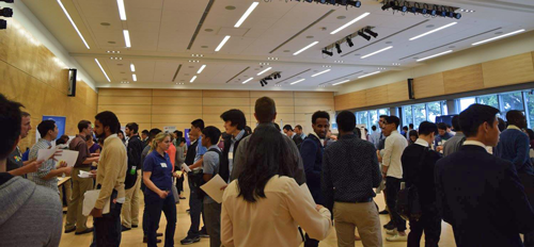
I woke up Friday morning thinking about preparing for a giant storm to hit Seattle while also planning to hand deliver a few of my wind prototypes to a large ballroom at the University of Washington for a career day event. They were expecting two to three hundred students to show up with resumes in hand, however I was told that more than 500 students came through to apply for summer internships at almost two dozen companies.

I was honored to be in the presence of recruiters from large companies such as Boeing, Microsoft, and the US Navy, but even more honored to be handed almost a hundred resumes from some of the most ambitious electrical and aeronautical engineering students I've ever met. Most of them already studied my website and had some great questions thought up inquiring about me and the future of Pterofin, Inc.

Needless to say I had a few incredible discussions with some very eager students who wanted to spend their time interning and helping develop Pterofin technology. Some of them were extremely passionate about the usefulness of the technology which helps deliver clean drinking water to populations who fight that battle day after day and year after year. Other students were very animated and passionate about the physics behind Pterofin technology, and how they'd absolutely love to be a part of my team doing R&D.

I can't even begin to tell you how excited I am about meeting some of the future leaders in technology, taking such an active interest in clean energy and playing their part to not only help save our environment, but also save lives on a global scale. I'd like to think they're all keeping their fingers crossed and hoping I'll get back to them before the fist day of their summer vacation, as I think that's how long it might take me to go through the stack of resumes and make my decision.